
From friction to flow: why we switched to empowered squads and how it is changing the way we work
The structural shift that changed how we collaborate, scale, and innovate

Every company reaches a moment when the structure that once worked starts working against it.
Sometimes it happens slowly. A few delays here, a bit of friction there.
Sometimes it hits all at once, when what used to feel natural now feels heavy, complicated, or strangely disconnected from what your company actually stands for.
For us at Futurewave, that moment came when we looked at how our teams collaborated.
We are a multidisciplinary studio by design: strategy, design, engineering and tech experts under one roof, solving innovative hardware and product development challenges.
In theory, that diversity should have been our biggest strength.
In practice? Our structure kept getting in the way.
Projects flowed from one discipline to another depending on the stage. Strategy to design. Design to engineering. Engineering to tech.
It felt like a relay race where the baton kept getting dropped.
Information gaps. Communication loops. Unclear ownership. Mismatched expectations.
And one question became unavoidable:
If we are an innovation studio, challenge the status quo for our clients every day, why were we keeping the status quo for ourselves?
That question led to one of the biggest changes in our company’s history:
we reorganized Futurewave into small, empowered, multidisciplinary squads.
Here’s why we did it, how we approached it and what we’ve learned so far.
The limits of competency-based teams
On paper, our old model made perfect sense.
Designers in one team.
Engineers in another.
Innovation strategists and tech experts in their own groups.
It looked clean. Organized. Logical.
In real life, it felt more like friction.
These disciplines don’t just have different skills. They have different mental models, ways of working, ways of communicating and ways of making decisions.
When a project moved from one team to the next, it was like shifting gears without using the clutch. You could make it work, but it wasn’t smooth.
We kept seeing the same patterns:
Teams optimizing for their discipline instead of the shared outcome
Missing context and info between project stages
Bottlenecks created by handovers
Unclear ownership (who actually decides?)
Reactive instead of proactive communication
A sense that everyone was responsible, which meant no one truly owned the whole project
None of this happened because people lacked skill or motivation. The structure simply did not reflect the reality of our work anymore.
We needed something that matched the complexity, interdisciplinarity and speed of the projects we were taking on.
So we started searching for a better way.
Why we chose a squad model
One insight kept coming back:
Our structure did not reflect our identity.
Futurewave’s strength is the tight integration of strategy, design, engineering and technology. But when disciplines sit in separate teams, you don’t get collaboration, you get silos.
We wanted more.
More collaboration.
More shared ownership.
More early alignment.
More fluid decision-making.
More learning between disciplines.
More true multidisciplinarity.
And we needed a structure that could scale sustainably.
That is where the squad model came in.
We were inspired by Spotify’s model, but we did not copy-paste it. We adapted it to a service-company reality. Our clients and projects operate differently from a product-led tech company, so our version needed to be flexible.
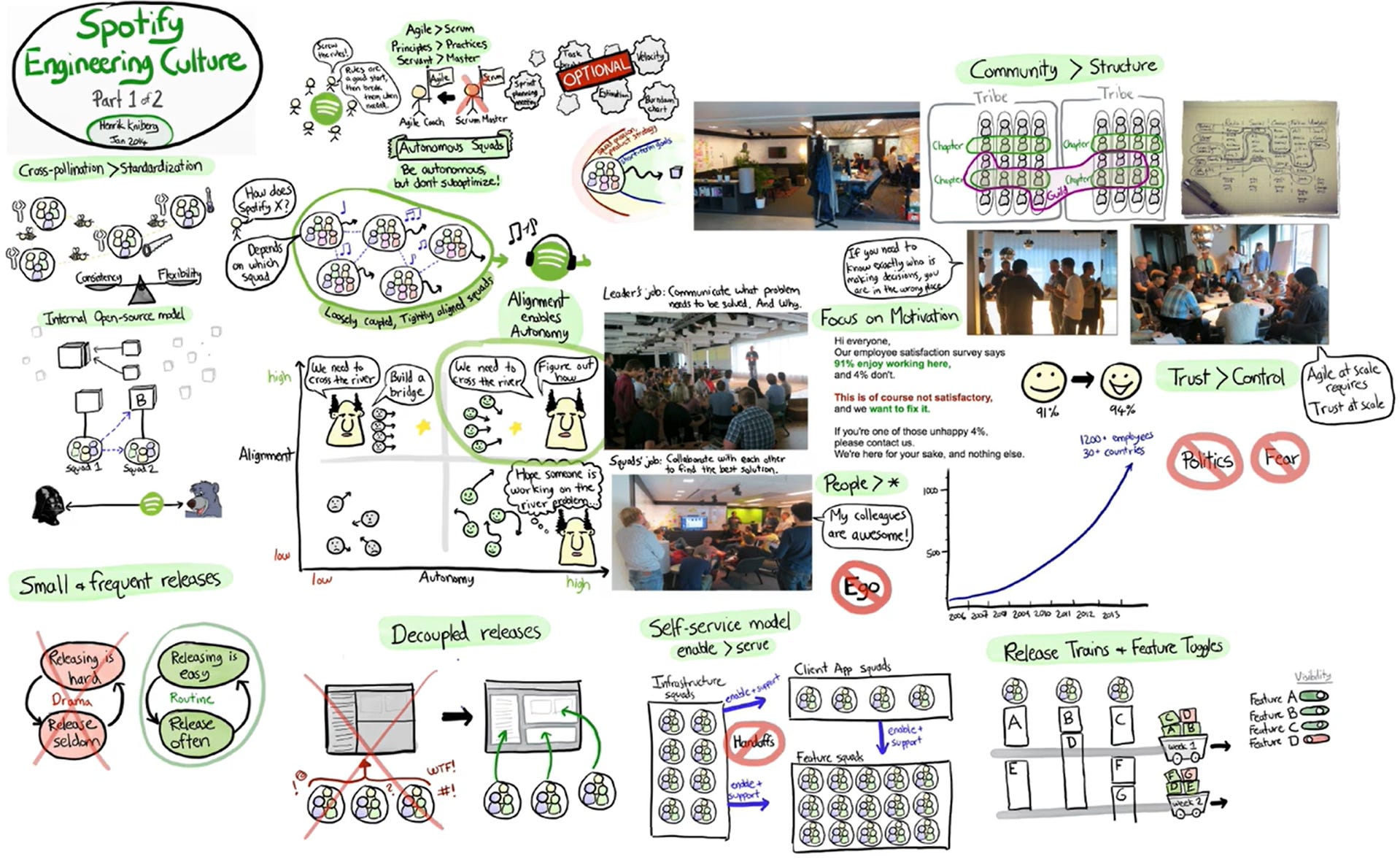
The squad model fit for several reasons.
1. It matches how we actually work, together
Modern projects are no longer linear. They require designers and engineers to collaborate from day one, not pass work over a wall. The squad structure embraces this.
2. It makes room for real empowerment
Squads own their mission. They decide how to organize, how to deliver, how to coordinate. Leadership provides direction and context, squads choose how to execute.
3. It reflects our belief in innovation
We encourage clients to challenge assumptions, explore new solutions, and evolve their products. We needed to apply that mindset internally. Staying static would have contradicted our DNA.
4. It helps us scale
A squad is a self-contained unit.
When we want to grow, we can create another squad as long as the mission is clear and the team is empowered.
This opens the door to something very powerful:
internal entrepreneurship.
People inside Futurewave can one day spot an opportunity, a new region, a new offer, a new type of client, and build a squad around that mission. It is a way for people to grow, explore, and take ownership far beyond their job description.
The squad model was more than an operational change for us. It was a way to align structure with identity, ambition, and culture.
What a squad looks like at Futurewave
A squad is simple in definition:
A small, stable, multidisciplinary team that can handle a project from A to Z.
Each squad includes:
Strategy
Design
Engineering
Tech
Project management
But what matters more is the mindset.
A squad has a mission.
Not just tasks. Not just clients. A purpose.
A squad is empowered.
The company leadership sets the strategic frame, the squad decides how to organize.
A squad owns outcomes.
No more “this belongs to design” or “engineering will decide later”.
The squad decides, together.
A squad is also a learning space.
People can take on responsibilities beyond their craft, operations, coordination, rituals, internal tooling, and more.
That autonomy is what turns a squad from a working group into a mini-company inside the company.
Our biggest fear: motivation
The biggest risk wasn’t structural. It was human.
This change cannot work unless people are motivated by it.
You can’t announce empowerment.
You can’t impose autonomy.
You can’t force ownership.
We worried about what might happen if people did not believe in the model, or if motivation did not spread naturally. We wondered whether some would feel confused or resistant, or whether the initial excitement would fade before the structure had time to settle. And of course, there was the fear that the culture would not follow the structure quickly enough.
The squad model is not something leadership can implement alone.
It only works if everyone is onboard.
That fear shaped how we designed the rollout.
Our change strategy: start with early adopters
We decided early on that we would not push this model onto the whole company in a top-down way. Instead, we took a more human, and in hindsight, much more effective approach.
We focused on the early adopters.
These were the people who naturally resonated with the idea, who saw the vision intuitively and immediately leaned in. They were excited, aligned, curious, and eager.
We doubled down on them.
Not to create favor or hierarchy, but to build momentum.
We invested more time with them. We explained the model in depth, tested early assumptions together, involved them in defining the new rituals and spoke openly about our own fears and motivations.
In short, we built trust first with those who were naturally aligned.
Why?
Because late adopters often base their motivation on what they see around them. If the first people to adopt the new model are excited, committed, informed, and engaged, that energy spreads naturally.
And it did.
Motivating the motivated first helped others feel curious instead of skeptical, included instead of forced. It created a positive chain reaction.
The hardest part: jumping before we felt ready
If you have ever redesigned a process, a workflow, or an entire company structure, you know this feeling:
You can overthinking it to death.
We spent months refining the framework. We rewrote processes, designed rituals, defined roles, improved the manifesto, mapped responsibilities and drafted playbooks.
But at some point, all the thinking becomes a comfort zone. You can always find one more thing to refine, one more document to finish, one more discussion to have.
The uncomfortable truth is:
Transformation only begins when you switch from planning to doing.
We weren’t 100% ready.
Probably not even 90%.
But real change rarely starts from completeness, it starts from courage.
So we jumped.
We flipped the switch.
We trusted that we would adjust in motion.
And yes, things did not go exactly as expected.
They never do.
But the model became real, and that was the only way forward.
How we rolled it out
We did not attempt a huge company-wide transformation in a single step. That rarely works, and it usually burns people out.
Instead, we focused on the big levers first.
Step 1: switch from competency teams to multidisciplinary squads
The biggest structural shift, and the most impactful.
Step 2: align the physical space
We changed the desk layout so squads sat together.
Small detail, huge impact.
Step 3: clarify missions and responsibilities
Every squad defined their own purpose within Futurewave’s frame. It is their focus area, a domain to own.
After that, we entered phase two, continuous improvement.
We met regularly with squads.
We listened, adjusted and clarified.
We added rituals when gaps appeared.
We redistributed responsibilities as people grew.
We improved processes as real-world friction surfaced.
Transformation became a journey, not a single moment.
Early results: the signals that told us we were on the right path
The first months after the switch were both telling and encouraging. Even if it is still early, we have already seen clear signs that confirm we made the right choice.
People are more motivated. Collaboration feels more natural and communication has improved significantly. Team members are taking on internal responsibilities beyond their core role, something that more rarely happened alone before. The organization feels clearer and the impact of multidisciplinarity is showing up in everyday work. Perhaps most importantly, autonomy has sparked a genuine increase in engagement.
These early signals did not appear because everything was perfect. They appeared because the collective energy shifted.
What we’re still learning
We are proud of the progress, but we know the work is not finished. The squad model works best when it evolves continuously. Today, we are still refining which rituals help squads the most, how to balance autonomy with consistency and how chapters and guilds should mature. We are learning how to support internal entrepreneurship, how to launch new squads the right way, how to maintain quality across disciplines and what leadership looks like in a structure built on empowerment.
This model was never meant to be implemented once. It is meant to be shaped over time.
Conclusion: the real transformation was cultural
Switching to squads wasn’t just structural.
It was cultural.
It aligned structure with identity.
It reflected our values: curiosity, collaboration, exploration.
It unlocked our multidisciplinary potential.
It made scaling more natural.
It restored clarity and ownership.
And most importantly:
It made us operate the way we always wanted to operate: innovative, connected and human.
We’re still learning.
Still refining.
Still improving.
But we’re building the kind of company we always imagined:
A place where autonomy and collaboration coexist.
Where people grow beyond their titles.
Where innovation isn’t just what we deliver, it’s how we work.
Thanks for reading! This post is public so feel free to share it.