
The Citroën ELO Strategy: Why the Future of Mobility Looks Like a Modular Gear Room on Wheels
What a compact EV concept reveals about scenario-driven design and parked utility

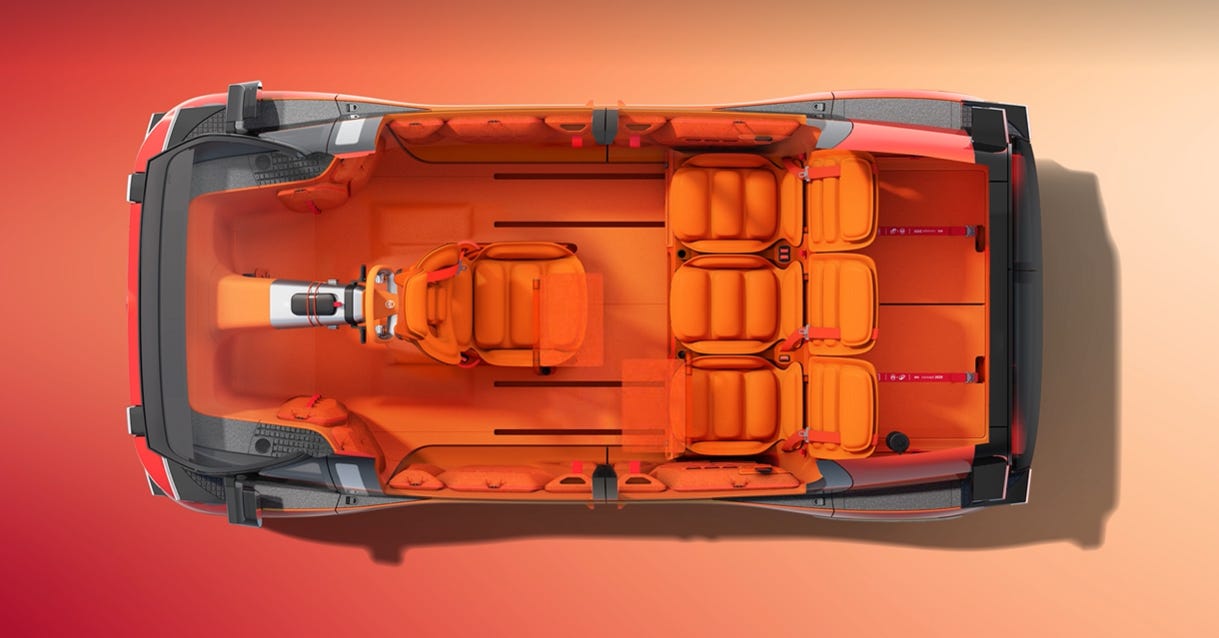
Citroën’s ELO concept, developed with Decathlon and Goodyear, is a compact EV (around 4.1 m) that treats the cabin as configurable space for daily life. The headline idea is simple: Work, Play, Rest becomes the design framework. When you unpack what that means in hardware, materials, and use cases, ELO becomes a useful lens on where automotive is headed.
This article unpacks five principles from the ELO concept worth carrying into future projects, plus one idea we think is missing.
5 Ideas Worth Keeping for Innovation
Five principles emerge from the concept that are worth keeping for any team working on next-generation vehicles. Here’s an overview, and more details below.
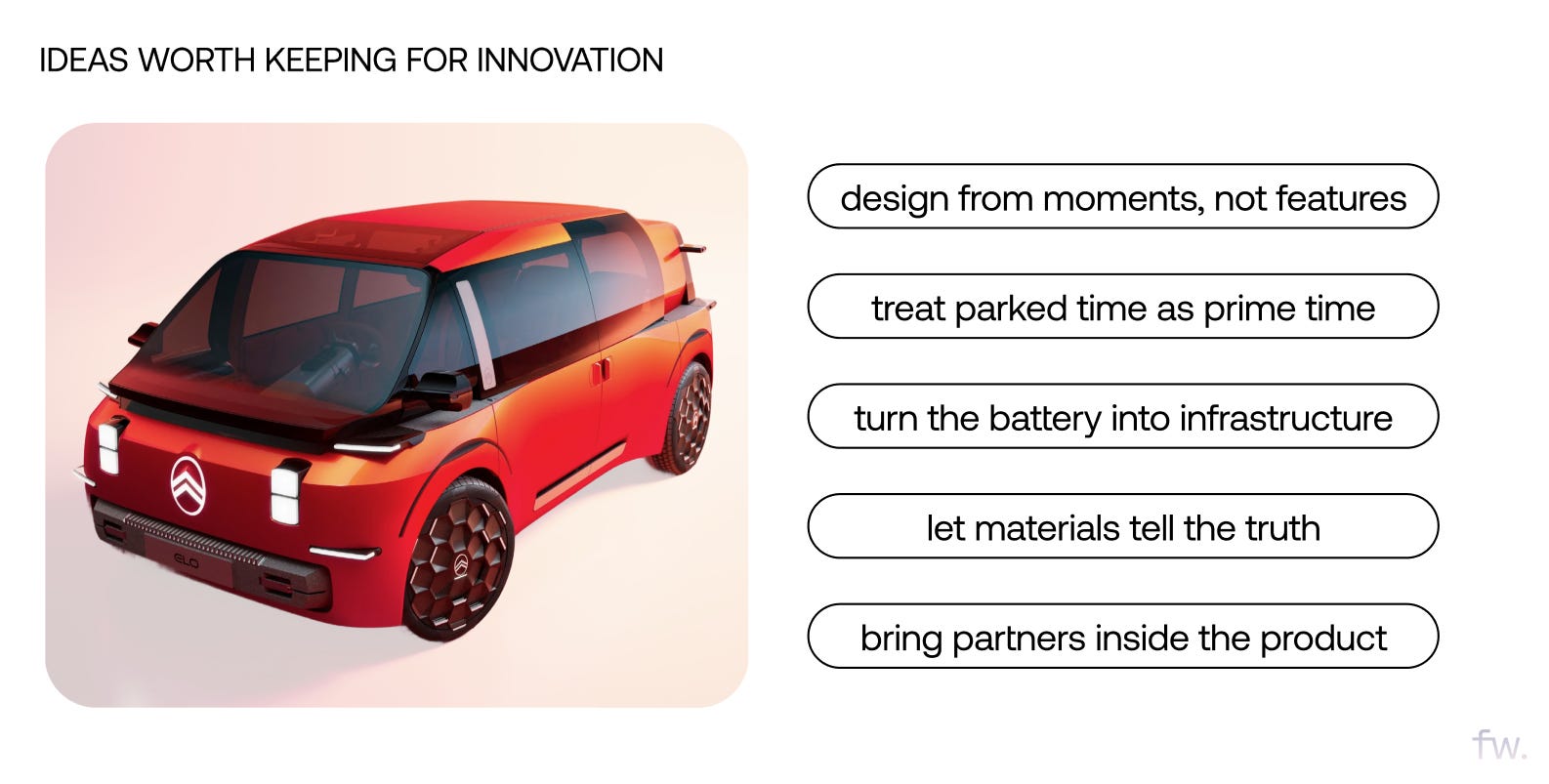
Design from moments, not features
ELO frames the car as a tool that adapts to different moments across a day or week.
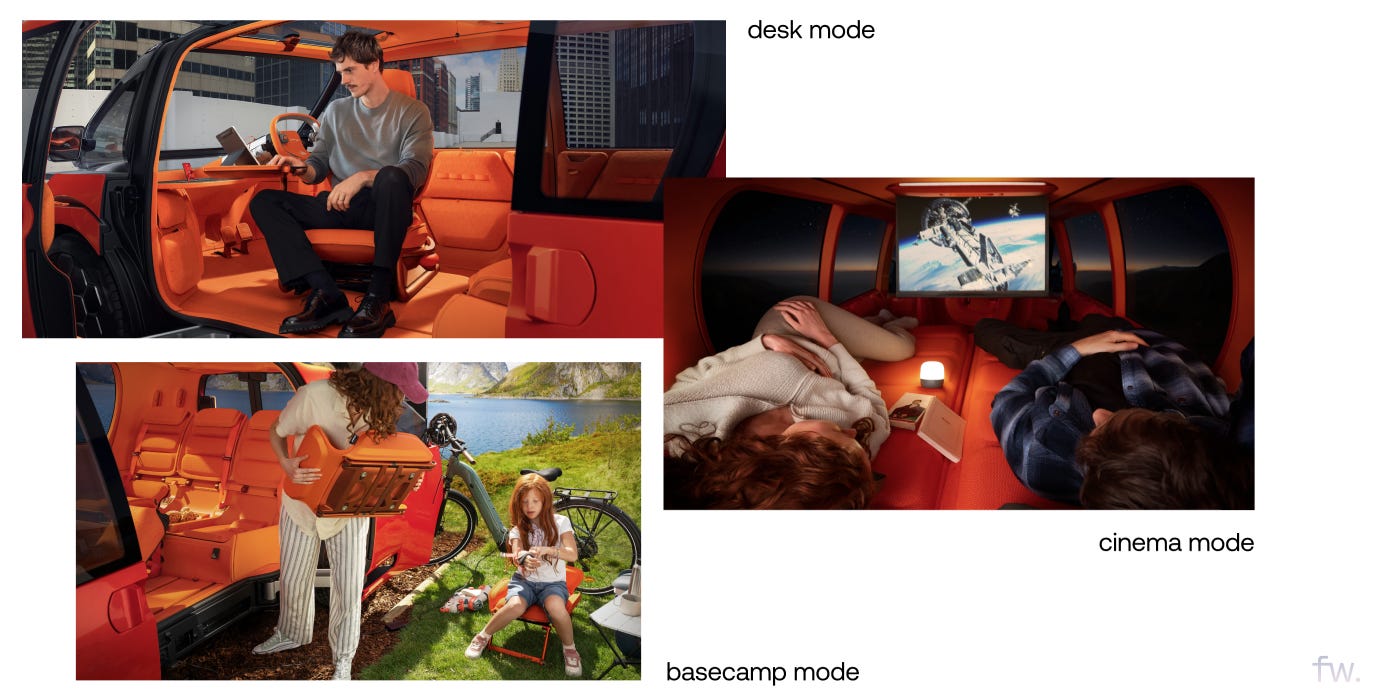
Work means a rotating driver seat and fold-out desk turning the front zone into a mobile workstation.
Play means extractable seating that becomes outdoor furniture, with the cabin behaving like a basecamp for cycling, paddling, or picnics.
Rest means two inflatable dropstitch mattresses stored in the trunk, plus a projector and integrated screen for a sleep-and-chill setup.
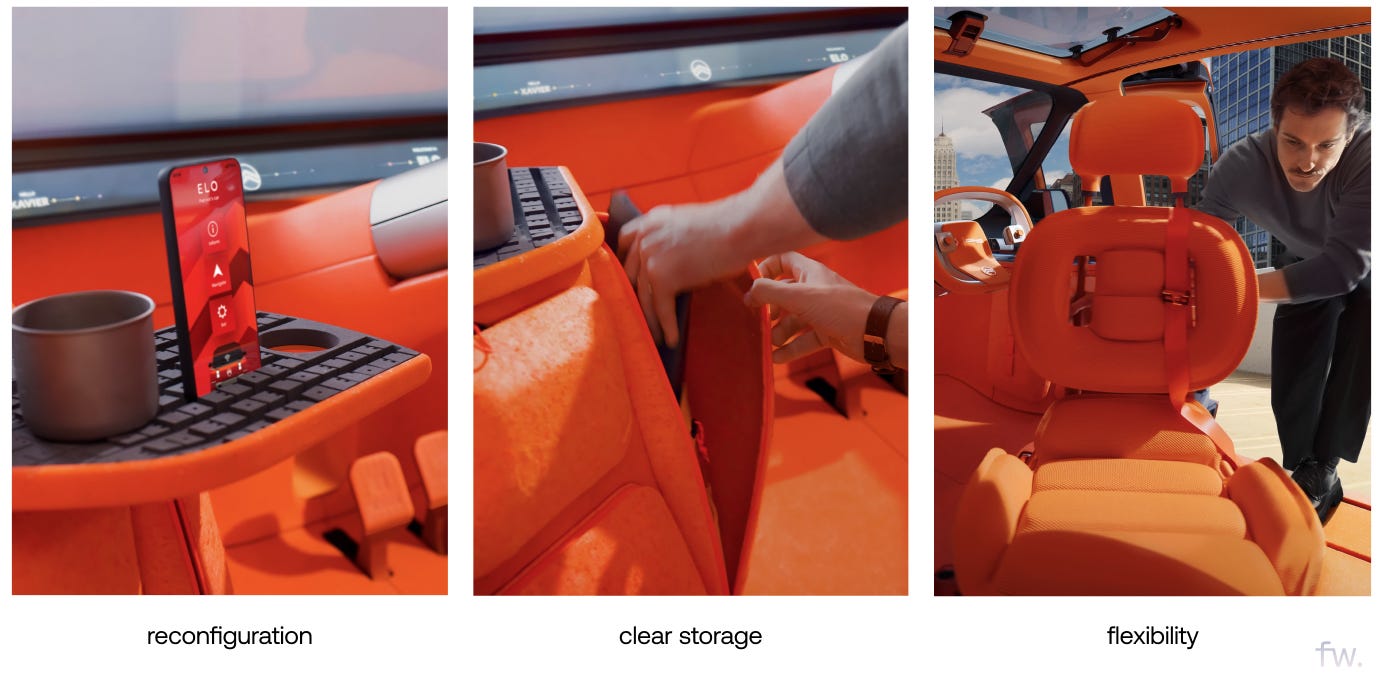
This mode logic drives the interior architecture. Extractable seats, flat surfaces, and clear storage zones make reconfiguration fast and intuitive. The cabin behaves like a kit rather than a fixed layout. Product teams need scenario maps alongside feature roadmaps: designing from use cases backward rather than stacking specifications forward.
Treat parked time as prime time
ELO treats stationary time as valuable. Desk mode, cinema mode, and basecamp mode all assume the car is used while stopped. Lighting, ergonomics, storage staging, and interior calm become strategic concerns rather than afterthoughts.
Access reinforces this flexibility. Opposing doors and a pillar-free side opening create a wide portal into the cabin (around 1.9 m), changing how passengers enter, how gear gets loaded, and how the space feels when parked. The radical access architecture is driven by real loading needs and inclusivity, not styling.
ELO uses EV packaging freedom to maximize volume in a short length: wheels pushed outward and a cabin-forward posture support a monovolume-style interior that aims for urban manageability without sacrificing capacity. The space works as well at rest as it does in motion.
Turn the battery into infrastructure
The utility layer goes beyond propulsion. V2L powers tools, cooking gear, and e-bikes, while integrated compressed air inflates paddles, tires, and mattresses. Together, they shift the EV battery from a drivetrain component to infrastructure for daily life.
This points to what might be called Vehicle-to-Activity utility. Power and compressed air turn the vehicle into a support system for hobbies and professional tasks. OEM differentiation can come from utilities that make activities easier, and accessory ecosystems become more legitimate as a result. Utilities beyond charging (air, power, lighting, mounting systems) may become standardized features rather than novelties.
Let materials tell the truth
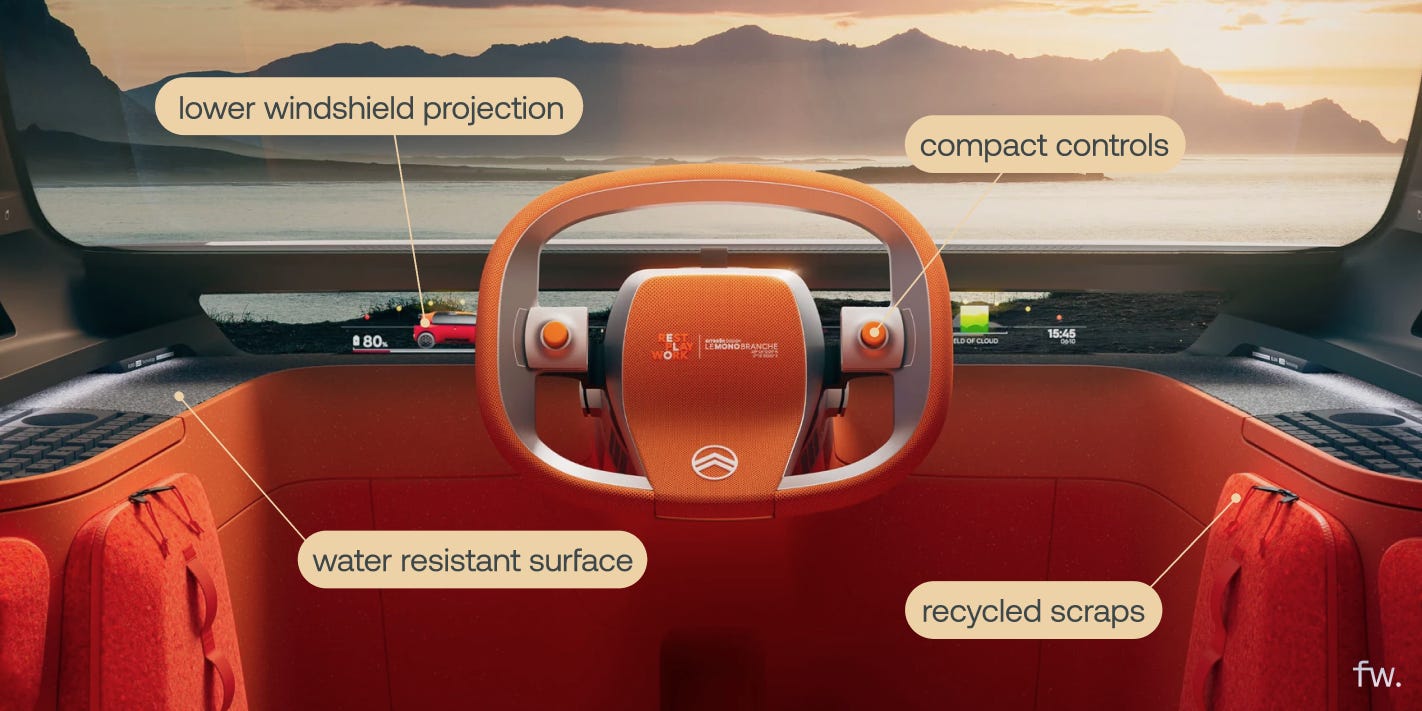
Surfaces are designed for hard use: exterior protection in recyclable expanded polypropylene, interior felts derived from recycled scraps, and finishes that resist water rather than fingerprints. Sustainability here means durability, replaceability, and materials that look like what they are.
Replaceable protective parts and visibly rugged materials move away from fragile “luxury” finishes. Sustainability becomes tangible through product decisions rather than marketing claims. Material honesty and repairability become brand signals. Modular interiors start to behave like product architecture, with components following their own lifecycle of replacement and upgrades.
The interface follows the same logic. ELO reduces dashboard complexity by projecting information onto a transparent film near the windshield, with compact joystick controls on the steering wheel. Projection and reduced screen dominance point to calmer, cheaper, less distracting HMI.
Bring partners inside the product
The partnerships read as functional contributions rather than branding exercises. Decathlon brings outdoor-use logic and activity-led design cues. Goodyear brings smart tire concepts with visible wear and pressure feedback. Citroën brings EV platform thinking and the willingness to treat the cabin as a living space.
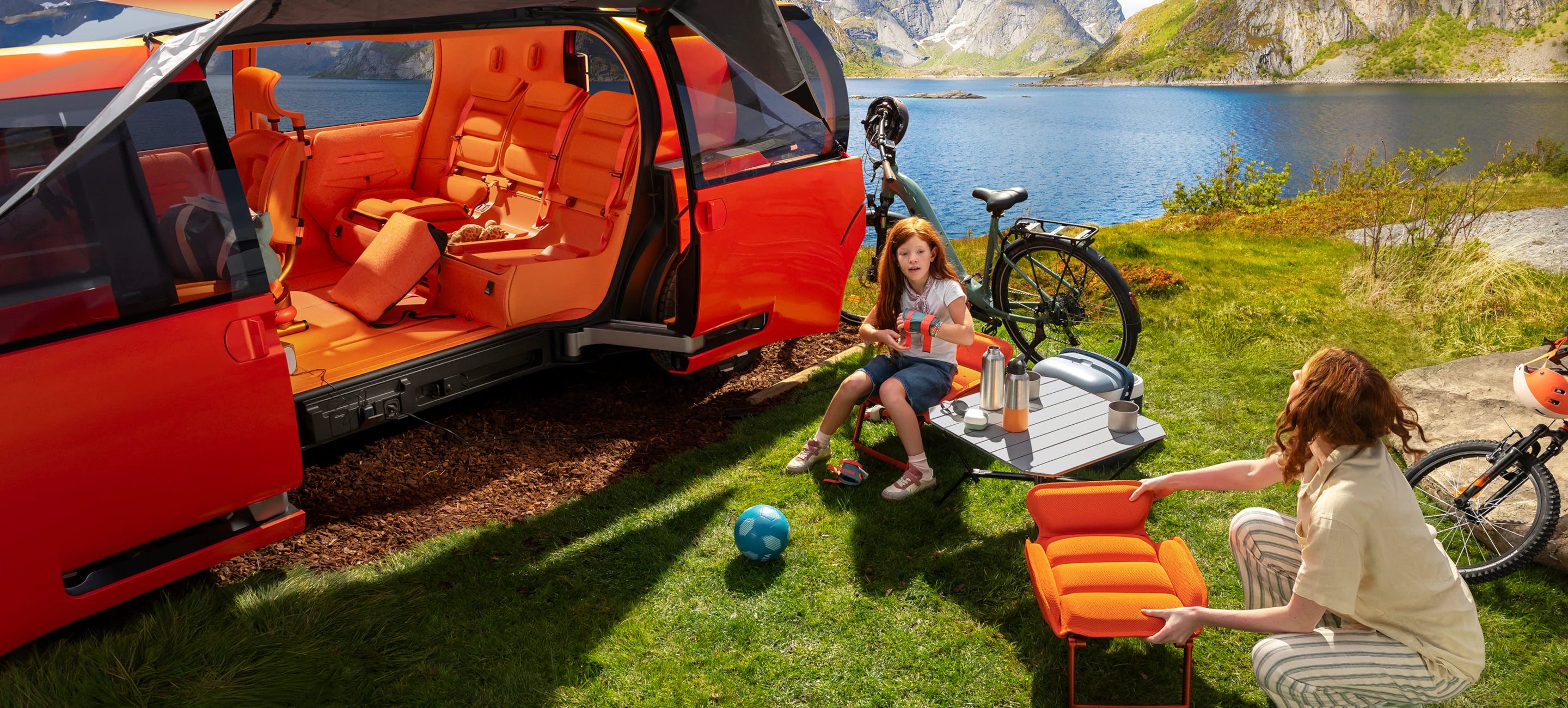
Decathlon and Goodyear are not decoration; their contributions shape user value directly. Retail, sports, materials, and consumer goods become serious sources of automotive innovation. Smart components communicating status visually (not only through apps) represent a shift in how suppliers can contribute to user experience.
What’s missing: design for the mess
A cabin built for outdoor life will encounter sand, mud, wet gear, and dogs. Rugged materials are a start, but true adventure-readiness requires thinking through the cleaning cycle. Sloped floors with drainage channels, removable panels for deep cleaning, an air blowing system to clear debris from seams, sealed compartments to protect electronics from splashes, a dedicated dirty zone near the tailgate. If the vehicle is truly a basecamp, it needs to handle the return from adventure as gracefully as the departure.