
Product Intelligence: When Technology Meets Emotion
Embedding the Fourth Foundation of Modern Product Development.


Foundation: The Current State
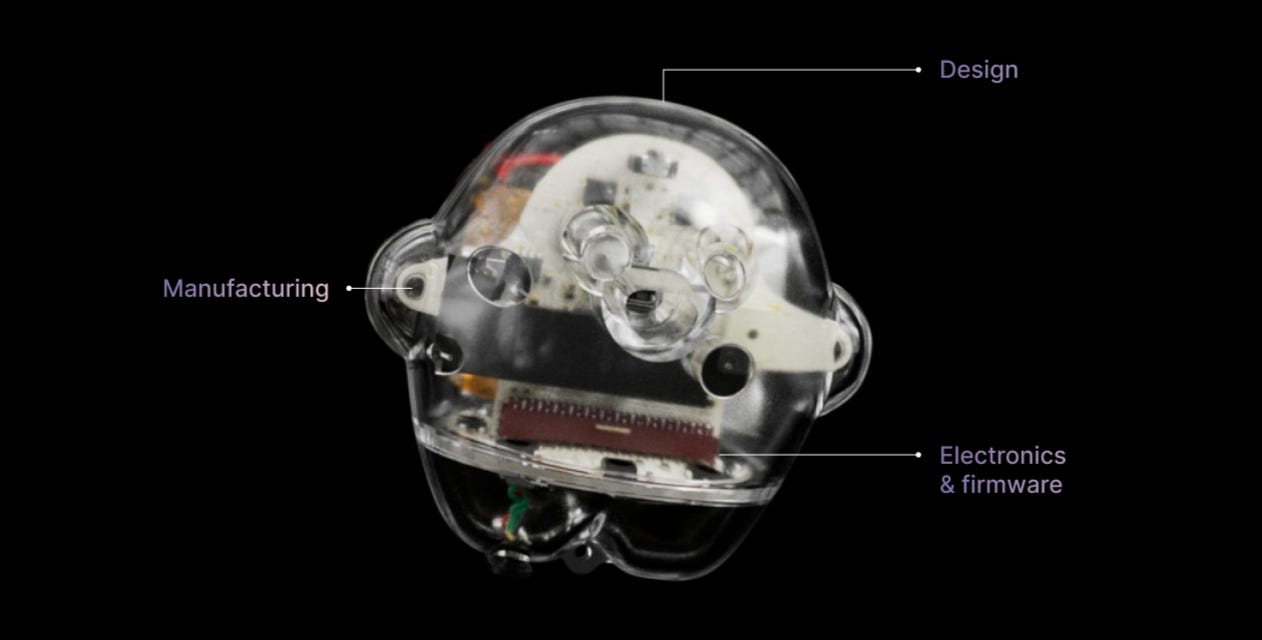
At Futurewave, we try to anticipate what the next generation of products will look like. For this, we start from how consumer products are currently built. From our experience, there are originally three core foundations behind today’s consumer tech product development: design, manufacturing, and electronics & firmware.
Design is about making the product lovable, enhancing the user experience, and finding the correct form factor and materials to create an emotional bond between the product and the user. When that job is done well, some products become part of your daily life without you even noticing. They become some kind of extension of your soul.
Manufacturing comes into play once the products have been designed and need to be made manufacturable. Electromechanical engineers start from the CADs made by designers in Fusion and dive into the engineering in Solidworks. Here, everything needs to be defined, from the most complex spring mechanism to the smallest bolt and calibration factors. Products come to life at this stage through 3D printing and constant back-and-forth with specialized suppliers and OEMs for future industrialization.
Electronics & firmware act as the brains of tech products. Products need to be programmed to act, which means creating custom-made PCBs with the right choice of components and the best matching microcontroller, finding the right balance between availability, costs, and performance. This is also the step where products become interactive with their environment. By connecting the product’s firmware to a back-end architecture, data can be transferred online via WiFi or LTE-M to interact with the products. Alternatively, recent advances in Bluetooth technology, especially BLE, allow products to exchange data seamlessly.
This might already sound quite state-of-the-art. It’s the wonderful intersection between IoT and product design, mixing function and emotion, making the world a more beautiful place by using technology in the right way.
Nevertheless, we like to think ahead at Futurewave. What if there was a novel spike for hardware consumer tech products? Something that would bridge the gap between the product and human emotions, where that extension of your soul we mentioned earlier actually comes to life. We strongly believe that we’re at the edge of adding a new foundation to product development: Intelligence.
The Fourth Foundation: Intelligence
According to the Cambridge Dictionary, intelligence means “the ability to learn, understand, and make judgments or have opinions that are based on reason.”1 As such, equipping products with intelligence would allow them to, for example, learn new tasks, understand context, and proactively take successive actions based on reasoning. These behaviors, however (almost) unseen in consumer tech products, are inspired by the robotics world, where AI has always been part of the embedded systems.
Intelligence in consumer tech products is on the start line of becoming a commodity in the coming years. With the rapid advances in AI research, from GenAI to reinforcement learning and beyond, embedding intelligence into products might soon become a norm. This intelligence will manifest far beyond simple chatbot interfaces, extending into rich multimodal interactions that seamlessly blend voice, gesture, visual cues, and environmental awareness.

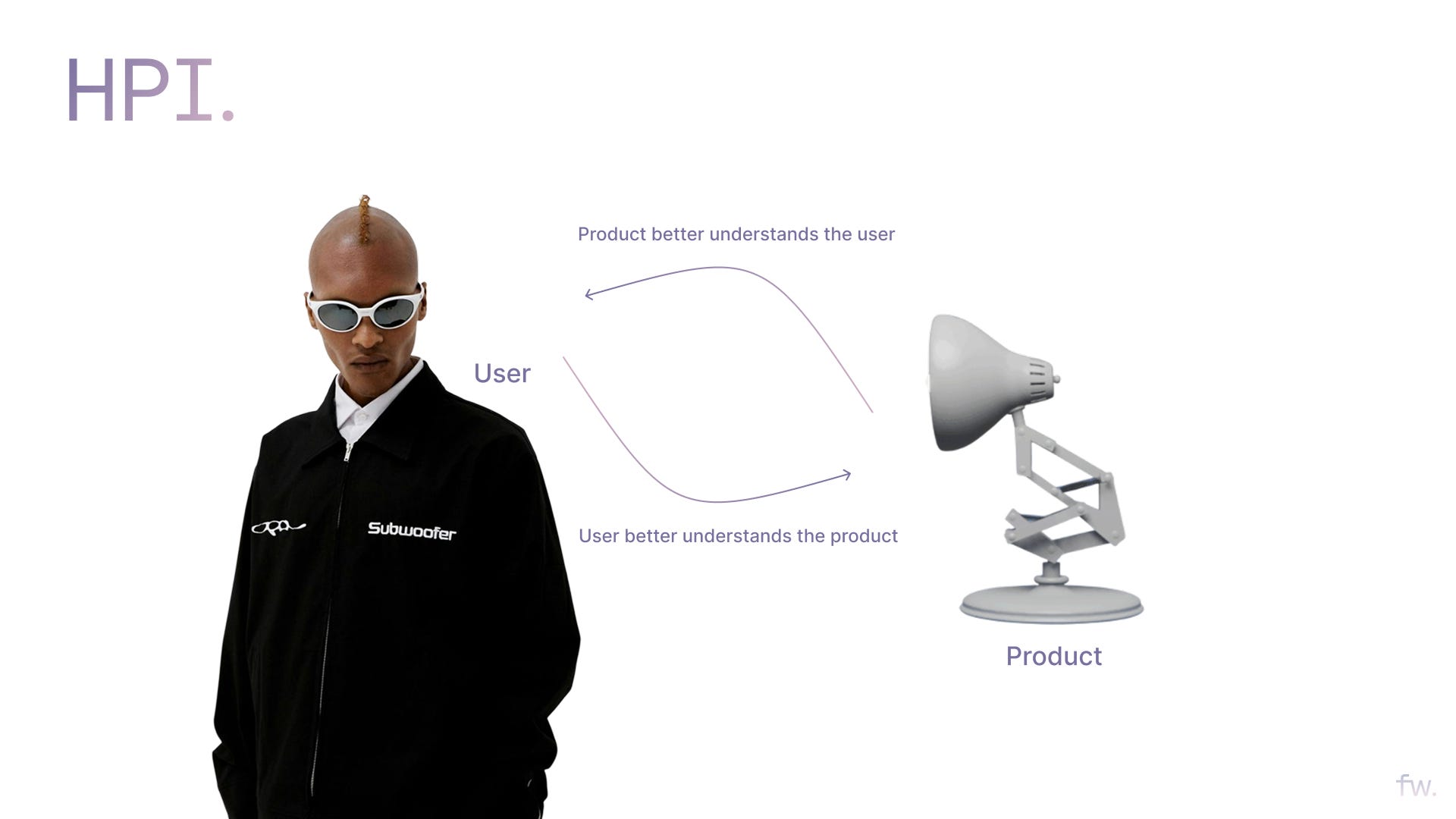
Intelligence creates a bidirectional understanding that transforms the entire product experience.
From one direction, it allows the user to better understand the product: what it thinks, which state it’s in, what it can do. This creates opportunities for more sustainable product use. Instead of throwing products away when a single feature stops working, the product will be able to indicate what is malfunctioning, why this is happening, and how to solve it. This aligns with our Design For Repairability DNA at Futurewave and supports the recent EU directive on repair of goods2.
From the other direction, intelligence allows the product to better understand the user through more personalized, adaptive interactions that grow with the user. You can create an emotional bond with your intelligent product, which makes it evolve from isolation to companionship. These interactions can take many forms: vocal, gestural, visual, touch, smell, and more, enabled by the rich mix of sensing technologies available today. We believe the challenge lies in achieving human-like interactions without anthropomorphism. Apple’s ELEGNT study3 explores this interesting topic around expressive, functional movement.
The true power of intelligent products lies in their ability to move beyond rigid, predefined user flows toward generative, adaptive experiences. Rather than navigating through complex menu systems, users will interact with products through intent-based communication – simply expressing what they want to achieve and trusting the product to understand and deliver. This “Do What I Mean”4 approach transforms the relationship between user and product, making technology feel more intuitive and less mechanical.
The Promise and the Peril
This paradigm opens up fascinating possibilities for products that are intentionally unfinished by design – evolving organically with user needs and behaviors over time. Rather than launching with a fixed feature set, intelligent products can continuously adapt, learn, and expand their capabilities based on real-world usage patterns and emerging user requirements.
However, this shift demands that users remain firmly in control. Intelligent products must provide clear, accessible ways for users to adjust, override, or refine AI-generated outputs. The goal is to be proactive without becoming intrusive – anticipating needs while respecting boundaries and preferences.
With these opportunities come significant responsibilities.
Cognition might shift away from humans to products, especially for younger generations. Outsourcing some tasks to devices and machines makes sense, but not at the expense of human cognition, which is our biggest asset to differentiate ourselves from other living species on Earth. If we are surrounded by intelligent products in our daily lives, we might start relying on them too much, until reaching a point of non return.
User need is equally important. Making products think by embedding AI should only be done if there is a genuine user need that delivers real, long-term value rather than mere novelty. This might either be a current need, responding to a market in demand, or an anticipated need. The latter would mean that people maybe don’t realize yet that integrating intelligence into some products might actually change living habits for the better (we hope).
Trust and safety cannot be overlooked. As products become more autonomous and capable of independent decision-making, establishing robust guardrails becomes essential. Users need to trust that their intelligent products will behave predictably and safely, while having clear visibility into how decisions are made and maintained control over critical functions.
Making Intelligence Real
The transition from software-based AI applications to physical, embedded intelligent products requires hands-on experimentation rather than theoretical planning alone. The complexities of integrating advanced language models and AI capabilities into hardware demand iterative prototyping and real-world testing.
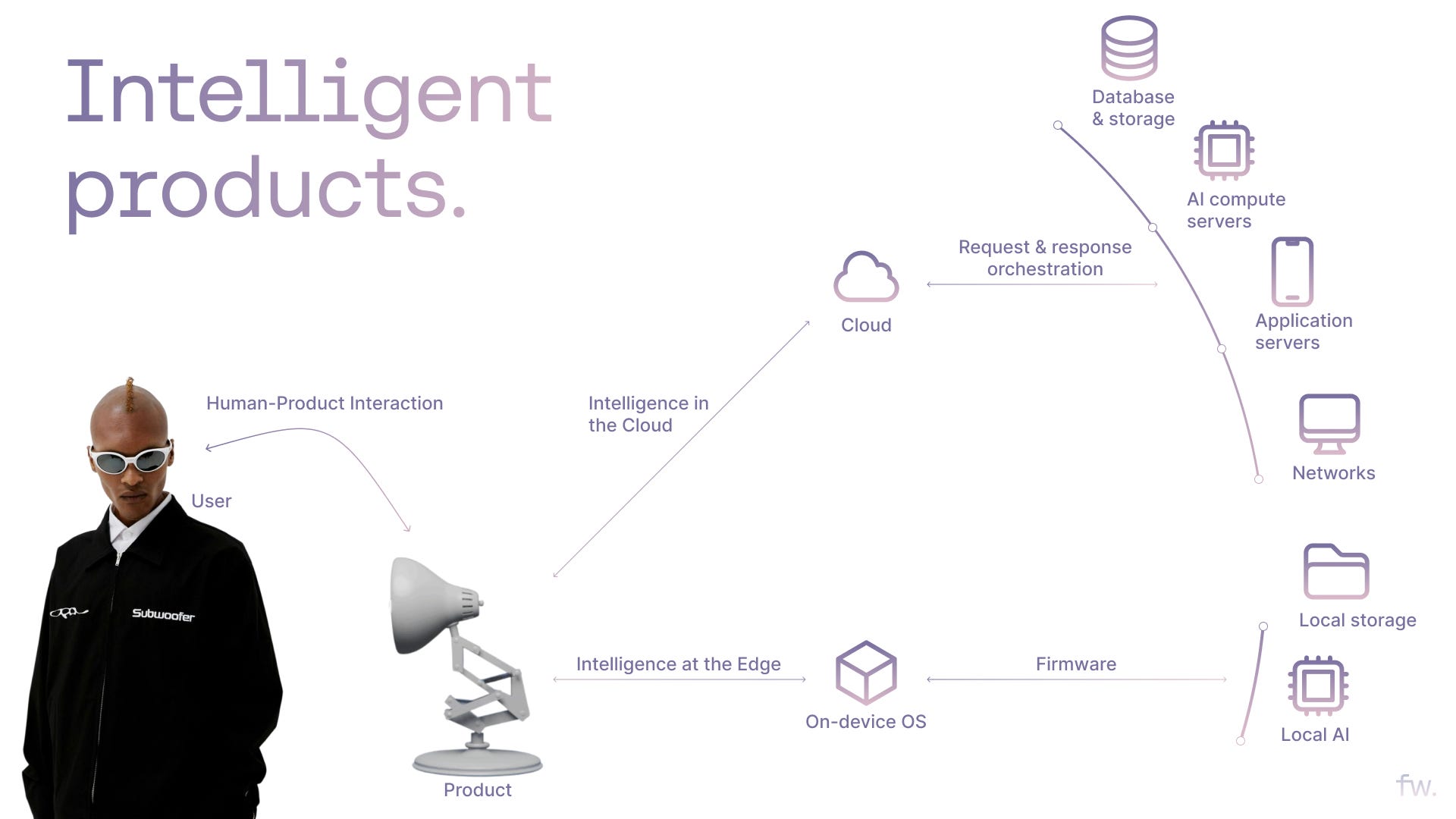
At the core, the Human-Product Interaction (HPI) can be augmented by intelligence, either coming from the Cloud or from the Edge. The Cloud allows for more computing power and access to more resources and applications, but requires internet connection and might become very expensive, depending on the number of AI tokens used. On the other hand, having the intelligence run on the Edge (on the device itself) requires less resources, is (almost) free to use after the hardware has been purchased, but is limited in computing power for very small processing units. The Nvidia Jetson5 family is often considered one of the strongest options in the context of Edge AI compute, but its volume is not discreet.
When leveraging Intelligence in the Cloud, the product connects to a comprehensive backend infrastructure that handles request and response orchestration. This cloud pathway links the product to databases and storage systems, AI compute servers for processing-intensive tasks, networks that enable communication with other devices, and application servers that manage the overall system logic.
Alternatively, Intelligence at the Edge runs directly on the device itself. Through the product’s operating system, the firmware can execute inference tasks using local AI models and access local storage resources like flash memory and RAM. This enables immediate processing without requiring internet connectivity.
The optimal approach often lies in a hybrid model that combines both pathways. Lightweight tasks can be processed locally on the device for immediate response, while more compute-intensive operations are delegated to the cloud when connectivity and budget allow. This flexible architecture enables intelligent products to deliver responsive, personalized experiences while efficiently managing computational resources and maintaining functionality even when connectivity is limited.
Conclusion
The future of consumer tech products isn’t just about better hardware or sleeker designs. It’s about adding intelligence as a fourth foundation alongside design, manufacturing, and electronics & firmware. This intelligence creates a two-way conversation between users and products, where both sides develop deeper understanding and more meaningful interactions.
The technology is ready. We can deploy intelligence through cloud computing for heavy processing or directly on devices for immediate responses, or blend both approaches for optimal performance. The real challenge lies in implementation: building products that are genuinely helpful without becoming intrusive, that enhance human capabilities without replacing them, and that evolve with users while keeping them in control.
At Futurewave, we see intelligence not as a flashy add-on, but as the natural next step in product evolution. The products that will define the next decade won’t just be smart, they’ll be truly intelligent companions that understand context, anticipate needs, and grow alongside the people who use them.
The question isn’t whether intelligent products will emerge, it’s whether we’ll design them thoughtfully. The work starts now, with prototypes, experiments, and real-world testing. Because the best way to understand the future of intelligent products is to build them.

Cambridge University Press, “Intelligence,” Cambridge Advanced Learner’s Dictionary & Thesaurus, accessed December 12, 2025, https://dictionary.cambridge.org/dictionary/english/intelligence.
European Commission, “Directive on repair of goods,” accessed December 12, 2025, https://commission.europa.eu/law/law-topic/consumer-protection-law/directive-repair-goods_en.
Yuhan Hu, Peide Huang, Mouli Sivapurapu, and Jian Zhang, “ELEGNT: Expressive and Lifelike Gesture Generation for Non-anthropomorphic Two-link agents,” arXiv preprint arXiv:2501.12493 (2025), https://arxiv.org/pdf/2501.12493.
Above Design Studio, “AI-enabled Products: Notes on products and experiences enabled by ML, LLMs, Agentic AI,” Experience Innovation Report #01 (2025), accessed December 12, 2025.
NVIDIA, “Embedded Systems for Next-Gen Autonomous Machines,” accessed December 12, 2025, https://www.nvidia.com/en-us/autonomous-machines/embedded-systems/.
 | A guest post by
|